The band likes to keep their hand in by signing promising bands to their own label, Reflex, which Mould says is currently "on hold." Independently, Hart has put his monetary muscle behind a few ventures — "Without any kind of involvement other than my financial backing," he stresses. "Right now, it's probably easier for us to produce something for someone else. There's a lot of ways of helping bands. I hate to say it, but our names on a record don't hurt a band. But that's not why we do it. It's a learning experience."
Mould seconds the motion. "It's real good for bands walking into something that looks like the cockpit of a 747, freaking out when they see all these bells and whistles going off, if there's somebody in there that can speak their language and say, 'That was a pretty fuckin' ripping guitar solo, why don'cha try it again?,' instead of just an engineer who will sit there. In that sense, I think we can put people at ease,share a little bit of the knowledge, debunk the mystery of the whole thing."
The Huskers lend a hand in other, more important, ways as well. After contributing a track ("Won't Change") to John Giorno's compilation LP A Diamond Hidden In The Mouth Of A Corpse, the band decided to add some oomph to the war against AIDS. Hart remembers: "There were royalties that were coming due, and me and Bob were sitting around the office and we said, 'Well, what if we donated this money to a charity for AIDS and challenged the rest of the artists on the album to match it?'"
"The main reason, for me," Mould points out, "was, y'know, I'm a human being and I sure as hell can't cure it, and I feel an obligation as part
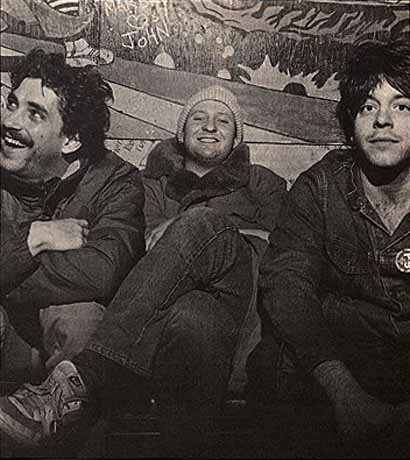
"Har, laddies!" Let's hoist a few
and talk some manly talk!"
And when the hat gets passed, the band expects their fans to show a little social consciousness as well. Hart tells a story about sifting through Husker Du correspondence. "We got a letter some months back from this guy and he has every one of our records except for these two that he can't get. I sent him the records, and as I was putting his address on, I noticed that it was a Park Avenue address, and so I enclosed a little note saying, 'This record here books in Goldmine for $25 and this other one is beyond that**; why don't you make a suitable donation to a charity, or take somebody out to lunch who is hungry?'"
In some ways, it seems, Husker Du have out-punked the punks, sidestepping shopping mall
Asked what effect Husker Du wants to have n their audience, Hart asserts, "Recharge them, invigorate them, love them, let it shine out for them." Mould sums it thusly: "Try to get some positive energy going." Maybe the band's cover of "Love Is All Around" — The Mary Tyler Moore Show theme song, written, oddly enough by Sonny Curtis, the author of "I Fought The Law" — wasn't all irony, after all.
*Many of the articles reproduced at this site came from zines that once were part of Moving Target Ken Chambers' Hüsker collection.
** It's a pretty good bet that these are, respectively, Statues and In A Free Land.
Back to magazine articles page